Etsy's search structure isn't Amazon's and isn't Google's: a title can run to 140 characters, a listing gets at most 13 tags, and each tag is capped at 20 characters. Thirteen is a hard ceiling, so tag slots are a budget to allocate, not a box to dump every word you thought of.
Use the tool: the Etsy Tag Planner splits your 13 tags using the six groups below and checks the 20-character limit, plural duplicates and brand terms. Free, no sign-up.
What AI is good for here is generating candidates inside those constraints and de-duplicating them. It can't tell you what buyers actually call your product.
Budget the 13 slots
A reasonable split:
| Type | Suggested count | Example (home candle) |
|---|---|---|
| Core category | 2–3 | soy candle, scented candle |
| Attribute / material | 2–3 | lavender candle, glass jar candle |
| Use case | 2–3 | bedroom decor, relaxation gift |
| Gifting / recipient | 2 | gift for mom, housewarming gift |
| Style / aesthetic | 2 | minimalist decor, neutral home |
| Long-tail combination | 1–2 | soy candle gift set |
Three rules:
- Don't spend 13 slots on synonyms. candle, candles and scented candle sitting together wastes ten of them.
- Prefer multi-word phrases. Single broad words are the most competitive; phrases match specific searches.
- 20 characters is hard. Over the limit simply won't save, so count mechanically during generation.
Don't duplicate what attributes already cover
Beyond tags, an Etsy listing has a category and attribute fields: colour, material, occasion, holiday and so on. Anything the attributes already express doesn't need a tag slot.
When listing, pick the deepest category level and fill in every attribute you can first. Then look at what information still isn't expressed anywhere. That's what the tags are for.
Titles: 140 characters, but the first words carry the weight
The 140-character limit isn't a target. Etsy's own guidance in recent years is consistent in direction: a title should read like a description a person can parse, with the most important words first, rather than a comma-separated keyword pile.
A workable structure:
[core category] [key attribute] [use case or recipient] - [style or material detail]
Avoid:
- stringing 20 terms together with pipes or commas;
- repeating the same word three or more times;
- leading with your shop name unless the brand itself has search demand;
- all caps, exclamation marks and promotional words.
Where AI fits: candidates and de-duplication, not judgement
A prompt that works:
You are an Etsy listing editor. Use only the product facts below; do not add materials, dimensions,
benefits or uses that aren't supplied.
Tasks:
1. Three English title candidates, each at most 140 characters, with the core category term inside the
   first 40 characters, readable as a sentence, no comma-stuffing;
2. Thirteen tag candidates, each at most 20 characters including spaces, labelled by type:
   core category / attribute / use case / gifting / style / long tail;
3. No tag may be a simple plural or synonym of another;
4. Output each tag's character count and the product fact field it comes from.
Product facts: ...
Once you have candidates, always do three things: count them with a tool (title ≤140, each tag ≤20), check for attributes that don't exist in the fact sheet, and delete tags that repeat what an attribute field already covers, replacing them with new information.
Three things a human still decides
- What buyers call it. You may say "aroma candle"; buyers may search "soy candle", "aromatherapy candle" or a holiday term. A model gives plausible guesses; the real vocabulary comes from your own shop search terms, support questions and competitor reviews.
- Holiday and seasonal words. When to add them and when to pull them depends on your stock and shipping times, which the model doesn't know.
- Trademarks and banned phrasing. Don't put brand names, film or TV IP, or obvious trademarks in tags to chase traffic.
Worked example: a handmade mug listing
Take a fictional shop selling a wheel-thrown stoneware mug with a speckled white glaze as an example. The fact sheet says: handmade, wheel thrown, stoneware, speckled white glaze, sold singly, gift wrap available. Category is set to the deepest mug level, with colour (white) and material (stoneware) filled in as attributes.
The first pass from the prompt above came back with 13 tags, and four of them failed the checks:
| AI tag | Characters | Problem | Replaced with |
|---|---|---|---|
| white mug | 9 | Colour attribute already says white | speckled mug (12) |
| handmade mugs | 13 | Plural of "handmade mug" | wheel thrown mug (16) |
| dishwasher safe mug | 19 | Not in the fact sheet | pottery gift (12) |
| handmade pottery mug gift | 25 | Over 20 characters, won't save | coffee lover gift (17) |
The title candidate was "Handmade Stoneware Mug, Speckled Mug, Pottery Coffee Mug for Coffee Lovers": core term up front, but "mug" three times. The edit kept the opening and varied the rest: "Handmade Stoneware Mug - Speckled White Pottery Coffee Cup, Wheel Thrown Gift for Coffee Lovers".
None of the four fixes needed judgement about buyers. They were mechanical, which is why the count-and-check step comes before anyone debates wording.
A prompt for refreshing tags on live listings
New listings are the easy case. Older listings tend to carry tags written before attributes were filled in. For those, give the model what's already there plus real buyer vocabulary:
You are an Etsy listing editor. Below are a live listing's title, its 13 tags, its filled-in
attributes, and search terms buyers have used to find this item.
Tasks:
1. Mark every tag that repeats an attribute value, is a plural or synonym of another tag,
   or is over 20 characters including spaces;
2. Suggest replacements only from words in the buyer search terms or the product facts;
3. Leave tags that match a buyer search term unchanged;
4. Output a before / after table with character counts and the reason for each change.
Title: [CURRENT TITLE]
Tags: [13 CURRENT TAGS]
Attributes: [CATEGORY AND ATTRIBUTE VALUES]
Buyer search terms: [SEARCH TERMS FROM YOUR SHOP DATA]
Product facts: [FACT SHEET]
Change one batch of listings at a time and note the date, so you can tell later which edit went with which shift in views.
Pre-publish checklist
- title ≤140 characters, core category term within the first 40;
- exactly 13 tags, each ≤20 characters;
- no plural-only or synonym duplicates among them;
- no tag repeating information an attribute field already carries;
- category set to its deepest level and attributes filled in;
- every attribute in the title and tags is visible in the photos and description;
- no trademarks, absolute claims or promotional wording.
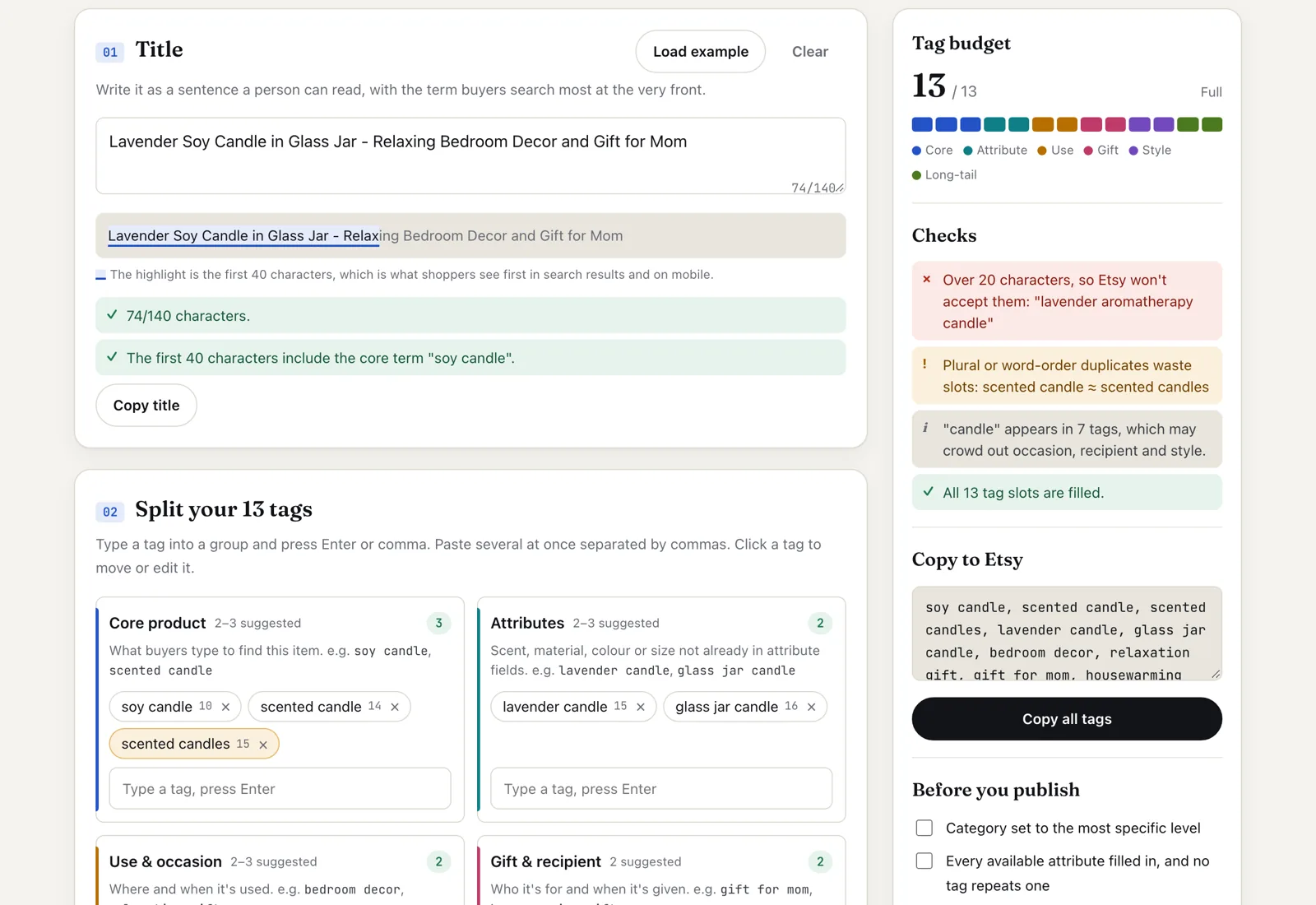
Screenshot taken 29 Oct 2026 in the free Etsy Tag Planner with its example listing loaded. "lavender aromatherapy candle" is flagged because it is over 20 characters, and "scented candles" is flagged as a plural duplicate of "scented candle".
FAQ
Should I use all 13 Etsy tags? Yes. An empty slot is budget you've left on the table. If you can't find 13 distinct phrases, that usually means the fact sheet is thin, not that the product needs fewer tags.
Do spaces count towards the 20-character tag limit? Count them, as the prompt above does. Squashing words together to fit makes a tag nobody types; pick a shorter phrase instead.
Do I need both singular and plural tags? No. Rule 1 above applies: a plural sitting next to its singular spends two slots on one idea. Use the second slot for information you haven't expressed yet.
How often should I change my Etsy tags? When something real changes: a new season, a new use case buyers mention, or a gap the shop's search terms reveal. Rewriting every listing at once means you can't tell which change did anything.
Listing the same products on your own store and Amazon too? Reuse the fact sheet from turning one product photo into a full Amazon and Etsy listing. Amazon's character rules are different. See optimising Amazon listings with AI.
The rules for your own store's page titles and descriptions are different. See writing Shopify product and collection meta at scale with AI.
To run through this checklist in one go, paste your tags into the Etsy Tag Planner. Red must be fixed; amber should be.
Sources checked 2026-08-28: Etsy: how to use tags to get found in search, Etsy: how to create a listing. Field limits can change; check the seller dashboard on the day you publish.